As a co-host of the 2030 FIFA World Cup, Morocco is executing time-bound programmes across airports, transport, stadium infrastructure, logistics, and supporting services.
As Morocco prepares to co-host the 2030 FIFA World Cup, the nation is delivering on a series of high-stakes, time-bound infrastructure programs. Projects across airports, transport and logistics are already financed and underway, fuelled by a decade of sustained foreign investment in automotive manufacturing and renewable energy.
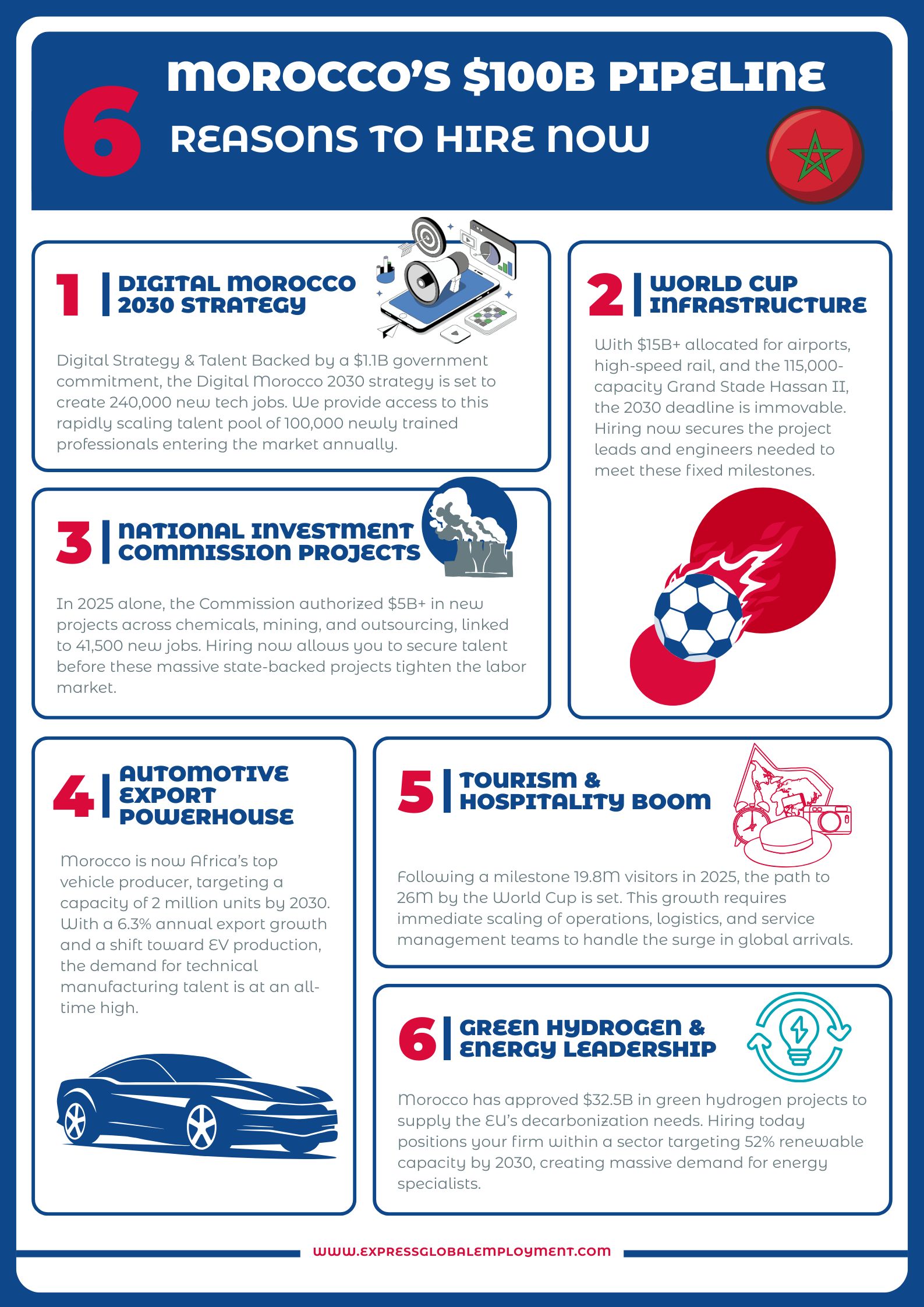
Parallel to this physical transformation is the Digital Morocco 2030 strategy — a billion-dollar roadmap designed to create 240,000 jobs and solidify Morocco’s position as a global digital and industrial hub.
This dual momentum is reshaping the employment market in Morocco. There is immediate, rising demand for engineers, project managers, and digital specialists who can deliver under tight 2030 timelines.
The employment decisions made between 2026 and 2028 will determine how companies navigate the 2030 peak and the transition beyond.
Acumen and AGA provide the local infrastructure, tailored employment solutions and compliance expertise to help businesses deploy their teams timely.
This article explores the sectors driving this expansion and how organisations can manage their workforce effectively as the 2030 horizon nears.
The 2030 Pipeline: Multi-Sector Talent Demand and Growth
1. Transport and Infrastructure
Morocco is investing heavily in transport infrastructure in the run-up to the 2030 FIFA World Cup.
Transport infrastructure accounts for one of the largest concentrations of capital expenditure ahead of 2030 and is a primary driver of workforce demand.
Airport expansion alone is being carried out under a programme valued at 38 billion dirhams (approximately $4 billion), with the stated objective of increasing national passenger handling capacity to around 80 million travellers per year by 2030. External financing forms part of this programme, including a €270 million facility from the African Development Bank. Works span multiple airports rather than a single hub, creating long-duration staffing requirements across construction, aviation operations, safety, facilities management, and technical services.
Rail development is progressing in parallel. Morocco has committed approximately 96 billion dirhams (about $10.3 billion) to rail infrastructure, including a 430-kilometre high-speed extension between Kenitra and Marrakesh. Beyond construction, the scale of the programme implies ongoing demand for signalling specialists, operations management, maintenance engineers, and compliance oversight as new capacity comes online.
Road transport investment adds a further layer. Public agencies have allocated around 12.5 billion dirhams, roughly $1.3 billion, to expressway and highway projects designed to improve connectivity between major cities and event locations. These projects extend labour demand into logistics coordination, site supervision, quality control, and long-term asset maintenance.
Taken together, these transport programmes generate employment requirements that extend well beyond build phases, with staffing needs persisting into operational readiness, testing, and post-delivery management.
Automotive and Manufacturing
Automotive manufacturing remains one of Morocco’s most industrially mature sectors and a significant source of employment. In 2024, automotive exports totalled 157 billion dirhams (approximately $17 billion), reflecting sustained production volume rather than short-term expansion. Output capacity continues to increase as manufacturers deepen their local footprint.
This expansion includes additional capital commitments from global manufacturers. Stellantis alone has announced investment of approximately €1.2 billion (around $1.4 billion) to increase vehicle output and extend local component sourcing, including production lines for electric and hybrid models.
The cumulative effect is a steady rise in demand for production engineers, maintenance and plant operations staff, quality and compliance specialists, logistics personnel, and technical trainers. Hiring is driven less by headline plant openings than by incremental scaling across existing facilities.
Energy Transition and Green Projects
Energy development has become a central component of Morocco’s long-term industrial planning, with targets extending well beyond conventional generation. Current programmes aim to increase installed power capacity in Morocco to approximately 27 GW by 2030, with renewables accounting for around 80% of total output.
Alongside wind and solar, Morocco has approved large-scale green hydrogen projects with an estimated combined value of 319 billion dirhams (around $32.5 billion). These projects are designed to support ammonia and industrial fuel production for export markets rather than domestic consumption alone.
Early-stage activity already requires specialist input across renewable engineering, environmental and permitting functions, safety and regulatory oversight, grid integration, and project finance. As projects progress, this demand is expected to persist across both local and international talent pools.
National Investment Commission Projects
Employment demand is also being shaped by investment programmes approved at national level. During 2025, Morocco’s National Investment Commission authorised projects representing approximately 17.3 billion dirhams in committed capital, spanning tourism, automotive manufacturing, renewables, outsourcing, and packaging. These approvals are associated with the creation of around 27,000 jobs.
In a separate approval cycle, the Commission endorsed additional projects totalling nearly 36.4 billion dirhams (around $3.6 billion), primarily concentrated in chemicals and mining, with more than 14,500 jobs linked to those investments.
Taken together, these approvals indicate that employment growth is being distributed across multiple industrial segments rather than concentrated solely in event-related infrastructure.
Tourism and Hospitality
Tourism continues to function as a large-scale employer alongside capital-intensive sectors. In January 2026, the Ministry of Tourism confirmed that Morocco welcomed a record-breaking 19.8 million visitors in 2025, representing a 14% increase year-on-year. This performance, which generated approximately $13.5 billion in revenue, officially positions Morocco as Africa’s top tourist destination.
Forward projections now target 26 million annual visitors by 2030, aligned with expanded connectivity and major event hosting.
This growth translates into sustained hiring across accommodation, transport services, venue operations, and event-related logistics. Demand is concentrated in urban centres and transport corridors, reflecting the geography of arrivals and hosting activity as the country moves from planning into delivery.
Digital Morocco 2030: The Second Engine of Growth
While physical infrastructure prepares for the World Cup, the Digital Morocco 2030 strategy is modernising the nation’s economic backbone.
Backed by the government’s $1.1 billion commitment through 2026, the strategy aims to create 240,000 new jobs and increase the digital economy’s GDP contribution by over $10 billion.
This strategy focuses on three critical areas for international businesses:
- The Outsourcing Hub: A push to position Morocco as a primary nearshore destination for Europe, targeting 40 billion MAD in digital export revenues.
- Tech Ecosystems: Development of 3,000 startups by 2030, supported by Jazari Institutes that train 100,000 young professionals annually in AI and coding.
- Cloud & Connectivity: The rollout of 5G and localised cloud regions (led by Oracle and others) to ensure high-speed, secure business operations.
Workforce Solutions by Acumen International in Morocco
Large-scale, time-bound projects in Morocco are driving sustained demand for skilled labour across infrastructure, industry, energy, and services.
Many employers need to scale teams quickly, manage fixed project durations, or wind roles down once delivery milestones are met, without creating long-term legal or entity exposure.
Through its global employment solutions in Morocco, Acumen International enables both multinational and Moroccan organisations to engage skilled local and foreign talent without requiring the client to establish or expand a local legal entity.
This applies across:
- long-term operational hires;
- fixed-term project roles;
- transitional build-phase teams;
- post-delivery wind-down arrangements.
Employment is structured compliantly under Moroccan labour law, with Acumen acting as the local statutory employer while clients retain operational control of day-to-day work.
Flexibility Across Contract Lengths and Project Phase
Ahead of 2030, employers need employment contracts that allow teams to scale up and down without creating long-term legal or financial exposure.
Acumen International supports:
- open-ended employment for core roles;
- fixed-term contracts aligned to project phases;
- role-specific structures that reflect build, peak, and transition periods.
This allows employers to increase or reduce team size as projects progress, without setting up or unwinding a local entity.
Global Employment Services with Immigration Support in Morocco
For projects linked to the World Cup 2030 timeline, foreign specialists are often critical to delivery. Engineers, senior managers, and technical experts are needed on site early, sometimes before local teams are fully built out. In these cases, the first constraint is not recruitment. It is expedited, compliant entry and the right to work.
Without a compliant sponsor able to support work authorisation in Morocco, foreign talent cannot be deployed at all. Delays or failures at this stage push entire project schedules out of alignment, regardless of how advanced planning or recruitment may be.
Acumen acts as the Employer of Record in Morocco, enabling the compliant sponsorship and employment of foreign specialists without the client establishing a local entity.
After work authorisation is granted, employment, payroll, and statutory registration are aligned so the individual can start work lawfully from the agreed date.
This Employer of Record arrangement is used where projects rely on foreign expertise being deployed on site at specific delivery stages, without the risk created by delays or informal hiring practices.
For employers, this means foreign specialists can be deployed in line with project timelines, without adding entity complexity or unmanaged compliance risk.
Projects in Morocco
Large projects in Morocco are often delivered by multiple contractors, recruitment firms, and specialist partners working together. AGA exists to make that collaboration workable at scale.
Acumen provides a shared employment and compliance foundation that partners can rely on when delivering joint projects. This avoids fragmentation across contracts, payroll handling, and statutory reporting as different firms contribute talent to the same programme.
This is particularly relevant where:
- teams operate across multiple sites or regions;
- roles change as projects move through build, peak, and transition phases;
- local and foreign talent are supplied by different partners.
Through the Acumen Global Alliance (AGA), recruitment firms and other employment delivery partners can combine talent access and execution capability, while relying on a common employment backbone rather than building separate, incompatible setups.
Conclusion
Morocco’s path to 2030 is already defined by committed projects and immovable timelines. For organisations involved in delivery, the practical question is not market entry or long-term presence, but how to align workforce deployment with fixed obligations while maintaining legal and operational clarity.
Acumen International, together with the Acumen Global Alliance, provide a robust employment and immigration layer that allows both international and Moroccan organisations to engage local and foreign talent under Moroccan law, across varying contract lengths and project horizons, without adding organisational complexity.